
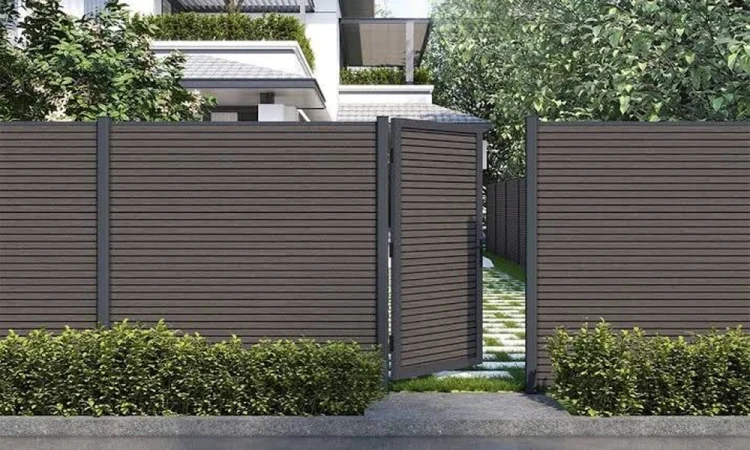
People spend serious money securing the front of a house, then leave the route down the side protected by a lightweight gate with a latch you can reach over and open. It is something I notice constantly when looking at garden boundaries. Good garden gates aren’t just there to stop the dog escaping or hide the bins. In the right position, they form another layer between the street and the less visible parts of a property.
That doesn’t mean every side gate needs to look like the entrance to a prison.
In fact, good residential security is often fairly understated.
What matters is making access difficult enough that somebody looking for an easy route has a reason to go elsewhere.
We think about front doors differently
The average homeowner wouldn’t dream of fitting a front door that could simply be pushed open.
We think about locks, keys, door construction, lighting and sometimes cameras. Yet move a few metres around the corner and the approach can change completely.
I’ve seen substantial houses with excellent front doors and decent boundary fencing where the side gate is held shut by little more than a basic slide bolt.
Sometimes the latch can be operated from outside.
Sometimes the hinges are accessible.
Occasionally the gate doesn’t close properly at all because the supporting post has moved.
That matters because getting through the gate can change the environment completely.
At the front of a house, somebody is exposed to neighbours, passing traffic and people looking through windows. Behind a closed side gate, they may suddenly have access to a much more private area.
Sheds, garages, bicycles, tools and rear doors are commonly found there.
The gate therefore isn’t protecting one piece of garden.
It is controlling access to everything beyond it.
Height matters, but it isn’t the whole answer
There is a temptation to treat security as a simple height competition.
Higher fence. Higher gate. Problem solved.
It isn’t quite that straightforward.
A very low gate obviously presents little physical deterrent. If somebody can comfortably step over it, its security value is limited.
But height needs to be considered alongside construction, locks, surroundings and visibility.
A tall gate with a weak latch isn’t particularly impressive.
Neither is a substantial gate attached to a rotten timber post.
If I’m looking at a side entrance from a practical point of view, I want to know whether the gate is structurally sound, whether it closes properly and whether the latch or lock can be reached from the public side.
I also look at what is next to it.
Could somebody stand on a wheelie bin and reach over? Is there a low wall alongside the gate? Does a neighbouring fence provide an easy foothold?
Security doesn’t exist in isolation.
The entire route needs considering.
A latch you can reach isn’t much of a barrier
This is one of the simplest problems to spot.
Close the gate and stand on the outside.
Can you reach the mechanism?
If you can, somebody else probably can too.
It sounds obvious, but gate furniture is often chosen for convenience from inside the garden without much thought about access from outside.
The right solution depends on how the gate is used.
A gate that needs regular access from both sides has different requirements from one that is normally locked and only opened occasionally. Key-operated locks, appropriate bolts and other gate-specific hardware can all have a place.
What I wouldn’t rely on for security is a fastening that can simply be reached over and released.
The gate might as well have a polite sign asking people to close it behind them.
Hinges deserve attention as well
People concentrate on locks because that’s the obvious security component.
I look at hinges too.
They need to be suitable for the weight of the gate, securely fixed and positioned sensibly. A large timber gate puts considerably more load through its hinges than a lightweight decorative one.
Poorly supported gates often begin dropping.
The owner then starts lifting the gate to get the latch into position. Eventually it stops closing properly and gets left unlatched because using it has become irritating.
At that point a maintenance problem has created a security problem.
If a gate suddenly starts dragging on paving or the latch no longer lines up, check more than the latch itself.
Look at the hinge fixings and supporting posts.
A dropped gate can be caused by the gate moving on its hinges, but it can also indicate movement in the post carrying it.
There is little point fitting a better lock to something that is gradually falling out of square.
Privacy and security aren’t always the same thing
This is where garden design becomes more interesting.
A solid boundary provides privacy. That’s often exactly what homeowners want.
But total concealment has a trade-off.
Police crime-prevention guidance generally treats the front and rear of a property differently. Visibility around the front can help with natural surveillance, while more secure boundaries are commonly appropriate around private rear areas.
That distinction makes sense.
If every part of a property is screened from public view, somebody who gets behind that screening may also be hidden from neighbours.
So I wouldn’t automatically recommend maximum-height solid fencing around every centimetre of every property in the name of security.
Think about what you’re trying to protect and from which direction.
A front garden boundary has a different job from the fence behind the garage.
The side gate is particularly important because it often marks the transition between those two spaces.
Don’t accidentally build a ladder
There is another detail worth checking around fences and gates.
Horizontal rails.
On many timber fences, rails are naturally positioned on the private side, which is usually preferable from a security perspective. Put easily accessible horizontal rails on the public-facing side and you may unintentionally create useful footholds.
The same thinking applies to gate design.
Decorative elements, cross rails and nearby structures can make climbing easier.
Again, this doesn’t mean residential fencing needs to become hostile.
Most homes do not need aggressive security fencing around the garden. They need sensible boundaries without obvious weaknesses.
For higher-risk commercial environments, the requirements are very different and purpose-designed security fencing may be appropriate.
For an ordinary house, the goal is usually simpler.
Control access. Avoid making climbing unnecessarily easy. Keep the gate locked when appropriate.
The wheelie bin problem
This one is remarkably common.
A homeowner installs a good gate and then leaves two large wheelie bins immediately outside it.
You have just supplied steps.
Bins, garden furniture, storage boxes and other moveable objects can all undermine an otherwise sensible boundary.
Think about sheds too.
A shed positioned directly against a fence may make access easier from one side while providing concealment on the other.
Security is rarely about one expensive product.
It’s usually a collection of small decisions.
The strongest gate available doesn’t help much if you’ve conveniently left everything needed to climb over it sitting alongside.
A side gate can protect more than the house
Rear gardens increasingly contain valuable equipment.
There are bicycles, power tools, barbecues, garden machinery and furniture. More households have outdoor offices, workshops and garden rooms than they once did.
Even the shed itself may contain thousands of pounds’ worth of equipment.
That changes the value of controlling access.
Somebody doesn’t necessarily need to enter the house to cause an expensive problem.
A secure side boundary also helps with opportunistic theft. Walking through an open or poorly secured gate is very different from having to climb a substantial boundary in view of neighbouring properties.
Nothing makes a property impossible to enter.
That’s not a realistic objective.
The point is to remove easy opportunities.
Don’t forget the fence attached to the gate
There is no point installing a substantial gate between weak fence posts.
The gate and surrounding boundary work as one structure.
I’ve seen cases where the gate itself is perfectly serviceable but the post carrying it has deteriorated at ground level. As the post moves, the gate drops, the latch becomes unreliable and eventually the entrance is regularly left open.
Other times the gate is much heavier than the original structure was designed to support.
This can happen when homeowners replace a lightweight gate with a large solid timber version without upgrading the supporting post.
The new gate may look far more secure.
Structurally, the arrangement can actually be worse.
If you’re improving a boundary for security, inspect the posts, panels and fixings around the entrance at the same time. A sound garden fencing system should work with the gate rather than treating it as an unrelated addition.
Lighting helps, but positioning matters
Security lighting can be useful around side access, particularly where the passage is naturally dark.
But more light isn’t automatically better.
A badly positioned floodlight that annoys the neighbours or repeatedly activates because of animals quickly becomes something people switch off.
The useful question is whether someone approaching or using the side entrance can be seen.
Lighting, cameras and alarms are additional layers. None compensates for a gate that doesn’t shut.
Start with the physical boundary.
Then add technology where it actually improves things.
Walk outside and try your own gate
The quickest security check is to stop looking at the property as its owner.
Walk outside.
Close the gate.
Look at it as though you’ve never been there before.
Can you reach the latch? Are the hinges exposed? Is there something nearby to stand on? Does the gate actually lock? Could somebody simply push it open? Is one section of the adjoining fence considerably lower? Are there tools or bicycles clearly visible through gaps?
Then walk through and look at what access to the rear garden gives you.
For many properties, that ten-minute exercise exposes weaknesses that have been sitting there for years.
Most don’t require dramatic solutions.
A better lock, repaired post, moved bin or properly closing gate might be all that’s needed.
Home security tends to attract attention towards expensive technology because cameras, alarms and smart devices are easy things to sell.
Sometimes the weak point is considerably less sophisticated.
It’s the wooden gate down the side of the house that hasn’t properly latched since 2022.