

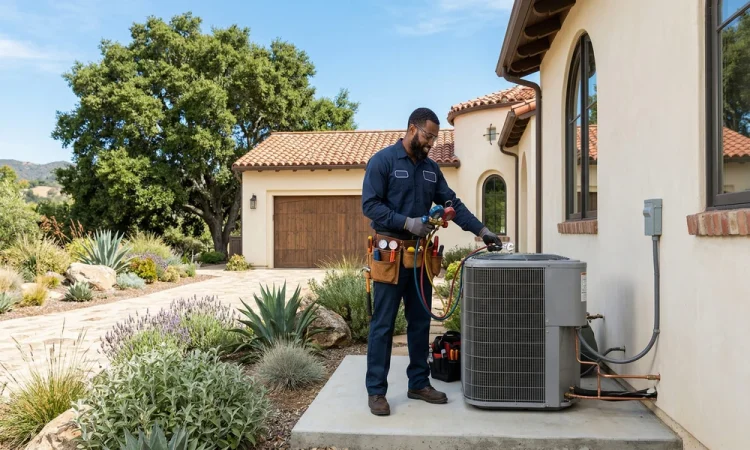
Sacramento County puts unusual demands on heating and cooling equipment. Summer stretches of 100°F days can run for a week or more, the Delta breeze often drops evening temperatures by 30 degrees, and wildfire smoke from the foothills and the North Coast can settle over the valley for days at a time. Since January 1, 2026, California’s 2025 Energy Code has applied to new HVAC permits as well. A 1950s ranch house in Arden Arcade, a two story tract home in Elk Grove, a stacked condo in Natomas and a strip center on Florin Road all face the same weather, yet each one needs a different approach to repair, upkeep and replacement.
Property owners searching for Sacramento County hvac services that cover all four of those building types can turn to unitedclimatecontrol.com, which runs separate residential and commercial teams for repair, maintenance and installation. The BBB accredited company is based in Auburn and works throughout Sacramento, Elk Grove, Folsom, Citrus Heights, Rancho Cordova, Carmichael and Fair Oaks. Its phones are staffed until 8 p.m. Monday through Thursday, which leaves room to call after the workday ends. For a building that needs attention, call (916) 953‑0411 and describe the property type, so the right crew shows up.
Older Single Family Homes
East Sacramento, Land Park, Arden Arcade and much of Carmichael were built between the 1940s and 1970s, often with ducts and air conditioning added decades after the house went up.
Repair. Many of these homes still run systems charged with R‑22. That refrigerant has not been produced in the United States since 2020, so recharging a leaking unit is expensive and only buys time. Wall furnaces, floor furnaces and undersized return grilles also show up often, and they explain many of the “one room never cools” complaints.
Maintenance. Ducts in crawlspaces and old attics leak, and leaky houses pull in outdoor air. During smoke events that becomes an indoor air problem. Sacramento County’s wildfire smoke guidance recommends running the air conditioner on recirculate and moving to a higher efficiency filter the system can handle. A technician should confirm that the blower can push air through a denser filter without starving the coil.
Installation. Replacements here usually involve more than equipment. Older duct wrap may contain asbestos, 100 amp panels may not support a heat pump with electric backup heat, and Title 24 requires duct leakage testing on most changeouts. Ductless mini splits are increasingly used for additions and rooms that the original ducts never reached.
Newer Tract Homes
Neighborhoods in Elk Grove, Natomas, Rancho Cordova and the newer parts of Folsom were mostly built from the 1990s onward, with air handlers in the attic and two stories under one thermostat.
Repair. Builder grade systems installed in the early 2000s are now reaching the end of their service life, and capacitor, contactor and blower motor failures cluster during the first long heat wave of the year. Clogged condensate lines from attic air handlers are another frequent call, sometimes noticed only after a ceiling stain appears.
Maintenance. The upstairs and downstairs temperature split is the defining complaint in these homes. Balancing dampers, checking that supply runs to second floor bedrooms have not come loose, and keeping the outdoor coil clear of grass clippings and cottonwood fluff all matter. The EPA’s guide to setting up a clean room during wildfire smoke is especially useful for families with one bedroom they want to keep cleanest.
Installation. Zoning systems with separate upstairs and downstairs thermostats are a common upgrade at replacement time. Homes built since 2020 generally came with rooftop solar under the state code, which makes an all electric heat pump an easier decision, and new equipment now ships with lower impact A2L refrigerants and built in leak sensors.
Townhomes and Condos
Midtown, Natomas, Campus Commons and parts of Citrus Heights have a large share of attached homes, where the equipment often sits somewhere other than a side yard.
Repair. Condensers on rooftops or small balconies are harder to reach, and package units on shared roofs may need HOA access before a technician can even look at them. Tight mechanical closets can make a simple blower repair slower than in a detached house.
Maintenance. Short duct runs are an advantage, but stacked units transfer heat between floors, and top floor homes often run their air conditioning far longer than the units below them. Outdoor coils on balconies collect dust and debris quickly.
Installation. HOA rules frequently control where new equipment can go and how it can look, so approval belongs early in the timeline. Permitting differs too. The City of Sacramento offers online HVAC permits for one and two family dwellings only, so larger attached buildings follow a separate review. Unincorporated areas go through Sacramento County, while Elk Grove, Folsom, Citrus Heights and Rancho Cordova run their own building departments.
Small Commercial and Retail Spaces
Strip centers, offices and restaurants along Sunrise Boulevard, Folsom Boulevard and Florin Road usually rely on packaged rooftop units.
Repair. Belt failures, failed economizer actuators and refrigerant leaks on aging rooftop units tend to appear on the hottest afternoons, when customers are inside and the space is fully loaded with lights and kitchen equipment.
Maintenance. Quarterly service suits most retail rooftop units here, with filter changes, belt checks, coil cleaning and economizer testing. During smoke events, economizers should be set to stop bringing in outside air, a step that many owners overlook. Restaurants need more frequent coil cleaning because of grease in the exhaust stream.
Installation. Rooftop replacements often need a crane, structural review if the new unit is heavier, and nonresidential Title 24 acceptance testing for economizers and controls. Tenant improvements that change a space from retail to a restaurant or gym can alter the required capacity and ventilation entirely.
Across every building type, the weather is the constant and the building is the variable. Knowing which category a property falls into explains why one owner’s repair turns into a duct project, why another’s replacement waits on an HOA board, and why a third’s maintenance plan revolves around rooftop smoke settings rather than bedroom temperatures.


